Studying MBBS in Uzbekistan: Important Considerations for Indian Students

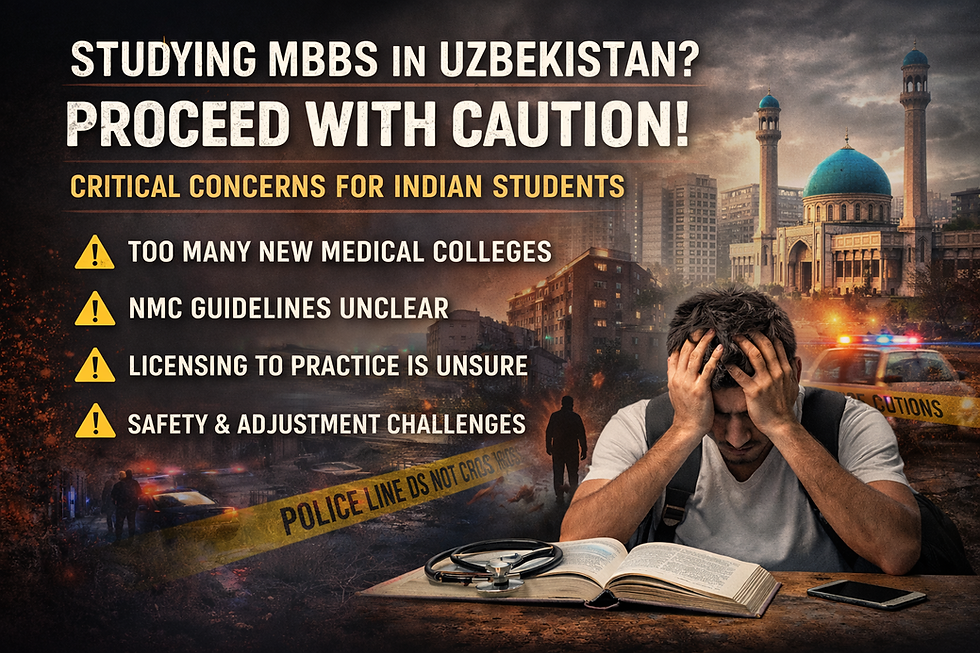
In recent years, Uzbekistan has rapidly emerged as a new destination for Indian students seeking medical education abroad. Several new medical colleges have been established, and aggressive marketing campaigns promote Uzbekistan as an affordable and “NMC-compliant” option for MBBS aspirants.
However, as with any newly developing education destination, students and parents must proceed with caution. Rapid expansion, limited long-term data, and ongoing regulatory uncertainties raise important questions that should be carefully evaluated before making a decision.
Rapid Growth of New Medical Colleges
A significant number of medical colleges in Uzbekistan have been established or expanded only in the last few years. While growth can indicate opportunity, it also brings challenges.
Many institutions lack a long track record of graduating international students.
Clinical exposure systems are still evolving.
Independent verification of infrastructure, teaching quality, and hospital integration is limited.
For medical education—where consistency and experience are critical—newness introduces uncertainty.
NMC Guidelines: Compliance vs. Confirmation
One of the biggest concerns for Indian students is compliance with National Medical Commission (NMC) guidelines.
While some universities claim alignment with NMC regulations, students should understand that:
There is no publicly confirmed, centralized list verifying long-term NMC compliance for all Uzbek medical colleges.
Course structure, duration, internship format, and medium of instruction must fully align with NMC norms—not just partially.
Future regulatory changes may affect eligibility for licensing exams in India.
Students often rely on agent assurances, but official clarity from Indian authorities is limited.
Licensing to Practice in India: Ongoing Uncertainty
Many students and parents remain unclear about the exact pathway to medical licensure in India after graduating from Uzbekistan.
Key concerns include:
Eligibility for licensing examinations depends on evolving regulations.
Internship recognition and clinical training acceptance may vary.
There is limited historical data on large numbers of graduates successfully completing the process.
Without clear, well-documented outcomes, students face uncertainty about their future practice rights.
Safety, Language, and Social Adjustment
Uzbekistan is culturally and linguistically different from India, and English is not widely spoken outside academic settings.
Language barriers can affect daily life, healthcare access, and emergency situations.
Social integration support for international students is limited.
Students may experience isolation due to cultural differences and lack of structured support systems.
Safety perceptions vary by region, but students should be prepared for adjustment challenges, especially when living independently for the first time.
Post-Admission Support and Ground Reality
Admissions are often facilitated by overseas education consultants whose involvement decreases significantly after enrollment.
Housing and hostel quality can vary widely.
Food arrangements and student welfare services may not meet expectations.
Dedicated mental health and international student support systems are limited in many institutions.
Students must be prepared to manage many aspects of daily life without consistent institutional support.
Education Abroad Requires Long-Term Clarity
Medical education is not just about securing admission—it is about:
Academic stability
Clinical training quality
Regulatory certainty
Personal safety and well-being
Long-term career outcomes
When choosing a newer destination like Uzbekistan, the lack of long-term data makes careful due diligence essential.
Conclusion: Proceed with Informed Caution
Uzbekistan is still an emerging destination for medical education. While it may offer affordable options, Indian students and parents should carefully assess the risks associated with new institutions, uncertain regulatory clarity, licensing pathways, and student support systems.
Independent research, direct verification with official authorities, and realistic expectations are crucial before making a commitment.
A cautious and informed decision today can help prevent academic and professional uncertainty tomorrow.
Author’s Note
This article is intended for informational and educational purposes only. It does not represent any university or authority. Students are advised to verify all academic and licensing requirements with official regulatory bodies before enrolling.

Comments